
Bubba Church
Date and Place of Birth: September 12, 1924 Birmingham, Alabama
Died: September 17, 2001 Birmingham, Alabama
Baseball
Experience:
Major League
Position: Pitcher
Rank: Unknown
Military Unit: 472nd Quartermaster Truck Regiment US Army
Area Served: China-Burma-India Theater of Operations
Major League Stats: Bubba Church on Baseball-Almanac
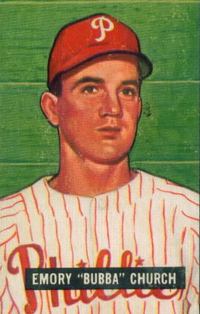 Emory N “Bubba” Church was born on
September
12, 1924 in Birmingham, Alabama. He attended West End High School
and entered military service with the Army at Fort McLellan, Alabama
on March 25, 1943.
Emory N “Bubba” Church was born on
September
12, 1924 in Birmingham, Alabama. He attended West End High School
and entered military service with the Army at Fort McLellan, Alabama
on March 25, 1943.
Church spent the next three months at Camp Sutton, South Carolina before heading for California and then on to India where he served 27 months with the 472nd Quartermaster Truck Regiment in the province of Assam near the Burmese town of Myitkyina on the Ledo-Burma Road. "It was uncomfortable," he told The Sporting News on August 23, 1950, "while the Japs were about 15 miles from us, but when they were cleaned out it was just like the Parkway in Philadelphia."
Church earned notoriety pitching for the 472nd in the Tea Patch League in India. "We had this young kid who just threw lights out," Ken Coleman - Hall of Fame broadcaster who also served with the 472nd - told author Todd Anton in No Greater Love. "We had some visiting pro players in to play against our team. The two guys that stood out on that team were Dixie Walker and Luke Sewell. He struck out 12 guys that day! Thus, the legend of 'Bubba' Church was born."
Discharged from the Army in late 1945, Church returned to high school and played semi-pro baseball with the Stockham Pipe Company. Church, received professional offers from the Tigers, Cardinals, White Sox and Pirates at this time, but chose instead to accept a baseball scholarship at Mississippi State University. He enrolled in September 1946 but two months later decided he wanted to play professional baseball.
Church joined the Philadelphia Phillies in the spring of 1947 at Clearwater. He was assigned to the Salina Blue Jays in the Class C Western Association and was 21-9 with a 2.93 ERA for the season. Furthermore, he batted .280 as an outfielder when not pitching.
The right-hander was promoted to the Toronto Maple Leafs of the Class AAA International League in 1948. The jump proved too much for Church and he was 5-9 during the season. But he remained with Toronto in 1949 and was 15-8, leading the International League with a 2.35 ERA.
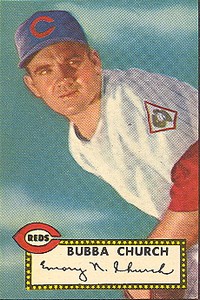 Church was 25 when he made his major league debut for the Phillies
on April 30, 1950. He made 31 appearances for the “Whizz Kids”,
started 18 games and had an 8-6 won-loss record with a 2.73 ERA.
Near-tragedy struck Church on September 15, 1950, when a hard-hit
line drive off the bat of Cincinnati’s Ted Kluszewski smashed into
his face. The ball was hit so hard that it caromed into right field
on the fly. Church had to be carried off the field by his teammates.
Little more than a week later he was back on the mound. Despite not
making an appearance in the World Series as the Phillies went down
in four straight games to the Yankees, his contribution to the team
during the regular season will always be remembered.
Church was 25 when he made his major league debut for the Phillies
on April 30, 1950. He made 31 appearances for the “Whizz Kids”,
started 18 games and had an 8-6 won-loss record with a 2.73 ERA.
Near-tragedy struck Church on September 15, 1950, when a hard-hit
line drive off the bat of Cincinnati’s Ted Kluszewski smashed into
his face. The ball was hit so hard that it caromed into right field
on the fly. Church had to be carried off the field by his teammates.
Little more than a week later he was back on the mound. Despite not
making an appearance in the World Series as the Phillies went down
in four straight games to the Yankees, his contribution to the team
during the regular season will always be remembered.
For Church, 1951 was his greatest season. He made 33 starts for a 15-11 record and a 3.53 ERA. In 1952, Church had pitched just two games for the Phillies before he was traded to Cincinnati. He was 5-9 with the Reds in a mainly relief role and was 3-3 the following season before being traded to the Cubs in June.
Church spent the majority of 1954 with the Los Angeles Angeles in the Pacific Coast League and threw a no-hitter against Portland on August 3. He made just seven appearances for the Cubs that year and was 1-3 with a 9.82 ERA. With the Angels again in 1955, Church made two relief appearances for Chicago. He was traded by the Cubs to Sacramento before the 1956 season but chose to quit the game instead.
Church returned to baseball in 1957 as a player-coach with the Miami Marlins of the International League. He also had some success in the Venezuelan Occidental League setting a strike out record with 16 in January 1958.
Church retired from baseball at the end of the 1950s. He had continued his schooling in the off-season attending Louisiana State University at Baton Rouge - majoring in business administration – and put this to good use running an insurance business and a linen service for doctor's offices.
Bubba Church was inducted in the Alabama Sports Hall of Fame in 2000. He passed away on September 17, 2001 in Birmingham, Alabama. He was 77 years old.
Created August 22, 2007.
Copyright © 2015 Gary Bedingfield (Baseball in Wartime). All Rights Reserved.
Home | About | Baseball in WWII | Player Biographies | Killed in Action | Those Who Served | Contact | Timeline | ETO | Service Games | Service Teams
Hall of Famers | Canuck | Negro | Japanese | POW | Battle of the Bulge | First To Go | Babe Ruth | WWII Publications | Book Reviews | Bibliography | Newsletter
Donate | Sponsor a Page | Links
Copyright © 2000-2025 Gary Bedingfield (Baseball in Wartime). All Rights Reserved.